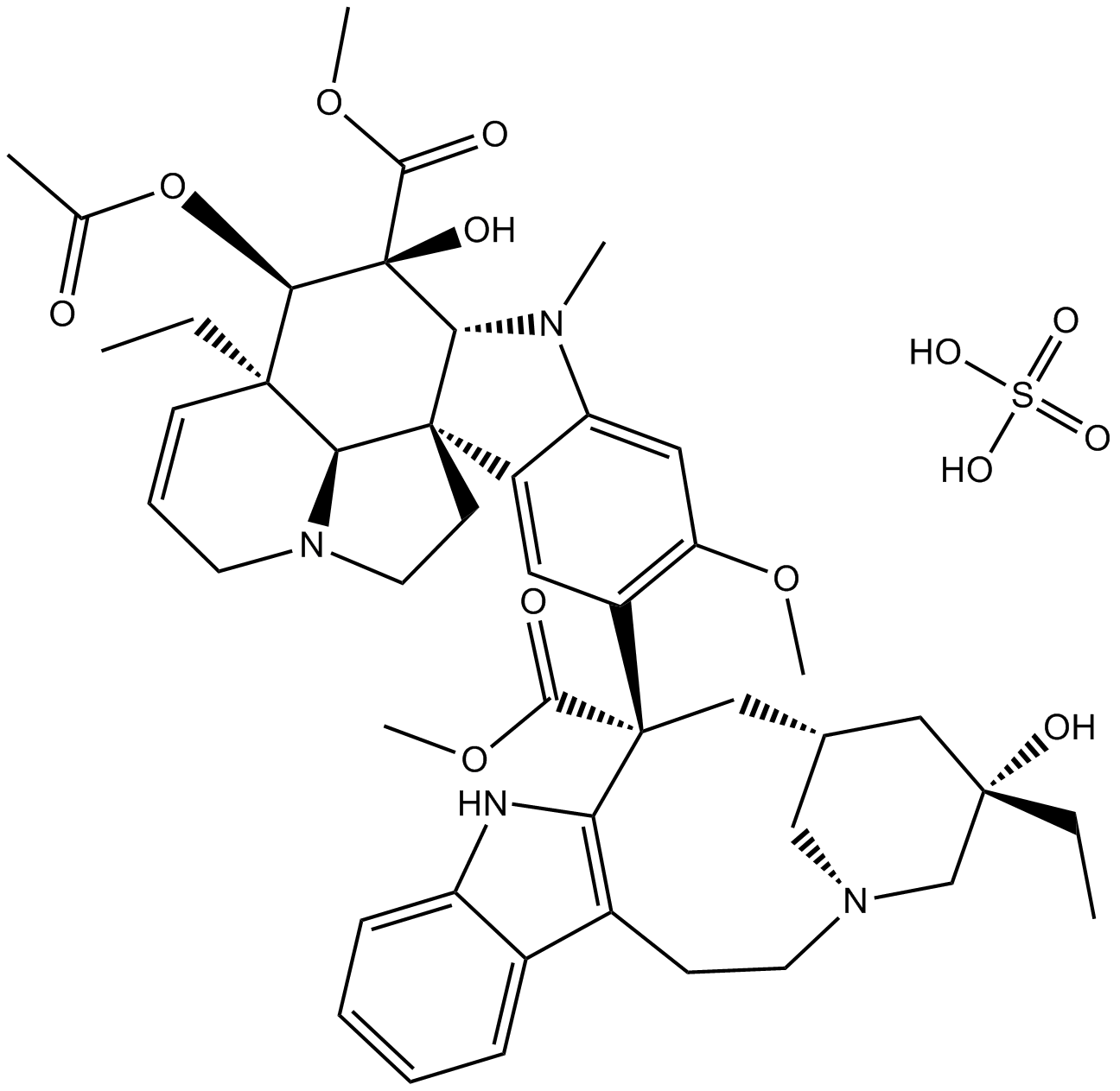
Experimental data indicate that the action of vinblastine sulfate (vinblastine sulfate injection) is different from that of other recognized antineoplastic agents. Tissue-culture studies suggest an interference with metabolic pathways of amino acids leading from glutamic acid to the citric acid cycle and to urea. In vivo experiments tend to confirm the in vitro results. A number of in vitro and in vivo studies have demonstrated that vinblastine sulfate (vinblastine sulfate injection) produces a stathmokinetic effect and various atypical mitotic figures. The therapeutic responses, however, are not fully explained by the cytologic changes, since these changes are sometimes observed clinically and experimentally in the absence of any oncolytic effects.
Reversal of the antitumor effect of vinblastine sulfate (vinblastine sulfate injection) by glutamic acid or tryptophan has been observed. In addition, glutamic acid and aspartic acid have protected mice from lethal doses of vinblastine sulfate (vinblastine sulfate injection) . Aspartic acid was relatively ineffective in reversing the antitumor effect.
Other studies indicate that vinblastine sulfate (vinblastine sulfate injection) has an effect on cell-energy production required for mitosis and interferes with nucleic acid synthesis. The mechanism of action of vinblastine sulfate (vinblastine sulfate injection) has been related to the inhibition of microtubule formation in the mitotic spindle, resulting in an arrest of dividing cells at the metaphase stage.
Pharmacokinetic studies in patients with cancer have shown a triphasic serum decay pattern following rapid intravenous injection. The initial, middle, and terminal half-lives are 3.7 minutes, 1.6 hours, and 24.8 hours, respectively. The volume of the central compartment is 70% of body weight, probably reflecting very rapid tissue binding to formed elements of the blood. Extensive reversible tissue binding occurs. Low body stores are present at 48 and 72 hours after injection. Since the major route of excretion may be through the biliary system, toxicity from this drug may be increased when there is hepatic excretory insufficiency. The metabolism of vinca alkaloids has been shown to be mediated by hepatic cytochrome P450 isoenzymes in the CYP 3A subfamily. This metabolic pathway may be impaired in patients with hepatic dysfunction or who are taking concomitant potent inhibitors of these isoenzymes such as erythromycin. Enhanced toxicity has been reported in patients receiving concomitant erythromycin. (See PRECAUTIONS). Following injection of tritiated vinblastine in the human cancer patient, 10% of the adio ctiv y was found in the feces and 14% in the urine; the remaining activity was not accounted for. Similar studies in dogs demonstrated that, over 9 days, 30% to 36% of radioactivity was found in the bile and 12% to 17% in the urine. A similar study in the rat demonstrated that the highest concentrations of radioactivity were found in the lung, liver, spleen, and kidney 2 hours after injection.
Hematologic Effects
Clinically, leukopenia is an expected effect of vinblastine sulfate (vinblastine sulfate injection) , and the level of the leukocyte count is an important guide to therapy with this drug. In general, the larger the dose employed, the more profound and longer lasting the leukopenia will be. The fact that the white-blood-cell count returns to normal levels after drug-induced leukopenia is an indication that the white-cell-producing mechanism is not permanently depressed. Usually, the white count has completely returned to normal after the virtual disappearance of white cells from the peripheral blood.
Following therapy with vinblastine sulfate (vinblastine sulfate injection) , the nadir in white-blood-cell count may be expected to occur 5 to 10 days after the last day of drug administration. Recovery of the white blood count is fairly rapid thereafter and is usually complete within another 7 to 14 days. With the smaller doses employed for maintenance therapy, leukopenia may not be a problem.
Although the thrombocyte count ordinarily is not significantly lowered by therapy with vinblastine sulfate (vinblastine sulfate injection) , patients whose bone marrow has been recently impaired by prior therapy with radiation or with other oncolytic drugs may show thrombocytopenia (less than 200,000 platelets/mm3). When other chemotherapy or radiation has not been employed previously, thrombocyte reduction below the level 200,000/mm3 is rarely encountered, even when vinblastine sulfate (vinblastine sulfate injection) may be causing significant leukopenia. Rapid recovery from thrombocytopenia within a few days is the rule.
The effect of vinblastine sulfate (vinblastine sulfate injection) upon the red-cell count and hemoglobin is usually insignificant when other therapy does not complicate the picture. It should be remembered, however, that patients with malignant disease may exhibit anemia even in the absence of any therapy.
Click here for Download pdf of patient informationTaj Pharma is one of the largest generic pharmaceutical company in India. We hold top positions in different established markets worldwide and are building a strong presence in many emerging generics markets. You can contact Taj Pharma India's business by telephone on 91 022-2637-4592, if you have an enquiry about the company, our healthcare business, or one of our medicines.
Vinblastine sulfate is a cytotoxic drug that arrests cell growth at the metaphase. Its actions are more pronounced on the rapidly dividing cell than on the normal cell.
Welcome to the Taj Pharmaceuticals Limited. We would like to give you an overview of Taj Pharmaceuticals: our background, organization, products, core belief and prospects.
Vinblastine use, safety information, warnings and side effects, indications and usage, adverse reactions and clinical pharmacology.
This section displays common question about the Vinblastine Solution for Injection.
Caution – This preparation should be administered by individuals experienced in the administration of vinblastine sulfate (vinblastine sulfate injection) . It is extremely important that the intravenous needle or catheter be properly positioned before any vinblastine sulfate (vinblastine sulfate injection) is injected. Leakage into surrounding tissue during intravenous administration of vinblastine sulfate (vinblastine sulfate injection) may cause considerable irritation. If extravasation occurs, the injection should be discontinued immediately, and any remaining portion of the dose should then be introduced into another vein. Local injection of hyaluronidase and the application of moderate heat to the area of leakage help disperse the drug and are thought to minimize discomfort and the possibility of cellulitis.
FATAL IF GIVEN INTRATHECALLY. FOR INTRAVENOUS USE ONLY.
See WARNINGS for the treatment of patients given intrathecal vinblastine.