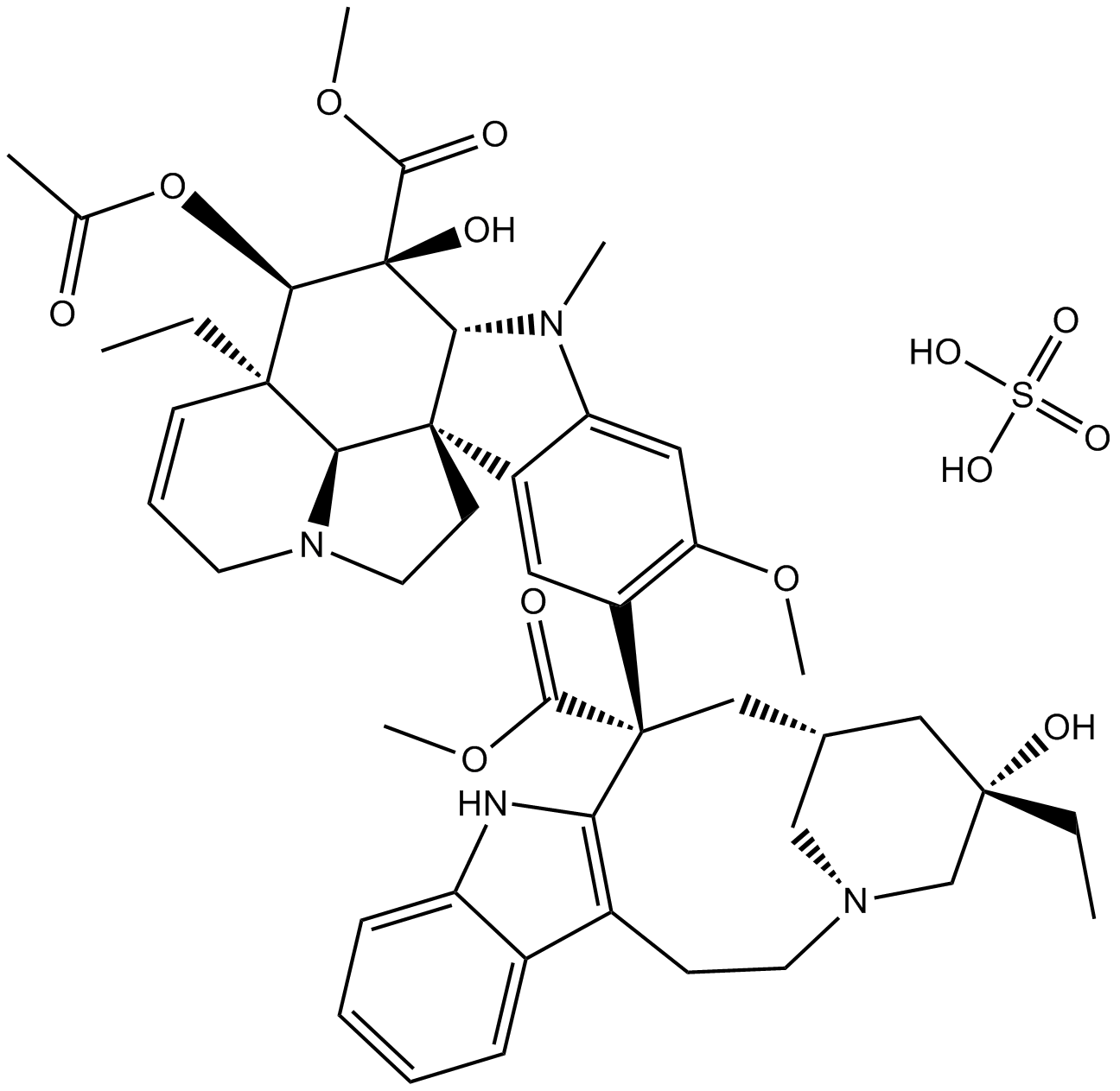
Vinblastine sulfate (vinblastine sulfate injection) is indicated in the palliative treatment of the following:
Frequently Responsive Malignancies
Generalized Hodgkin's disease (Stages III and IV, Ann Arbor modification of Rye staging system)
Lymphocytic lymphoma (nodular and diffuse, poorly and well differentiated)
Histiocytic lymphoma
Mycosis fungoides (advanced stages)
Advanced carcinoma of the testis
Kaposi's sarcoma
Letterer-Siwe disease (histiocytosis X)
Less Frequently Responsive Malignancies
Choriocarcinoma resistant to other chemotherapeutic agents
Carcinoma of the breast, unresponsive to appropriate endocrine surgery and hormonal therapy
Current principles of chemotherapy for many types of cancer include the concurrent administration of several antineoplastic agents. For enhanced therapeutic effect without additive toxicity, agents with different dose-limiting clinical toxicities and different mechanisms of action are generally selected. Therefore, although vinblastine sulfate (vinblastine sulfate injection) is effective as a single agent in the aforementioned indications, it is usually administered in combination with other antineoplastic drugs. Such combination therapy produces a greater percentage of response than does a single-agent regimen. These principles have been applied, for example, in the chemotherapy of Hodgkin's disease.
Hodgkin's Disease: Vinblastine sulfate (vinblastine sulfate injection) has been shown to be one of the most effective single agents for the treatment of Hodgkin's disease. Advanced Hodgkin's disease has also been successfully treated with several multiple-drug regimens that included vinblastine sulfate (vinblastine sulfate injection) . Patients who had relapses after treatment with the MOPP program– mechlorethamine hydrochloride (nitrogen mustard), vincristine sulfate, prednisone, and procarbazine–have likewise responded to combination-drug therapy that included vinblastine sulfate (vinblastine sulfate injection) . A protocol using cyclophosphamide in place of nitrogen mustard and vinblastine sulfate (vinblastine sulfate injection) instead of vincristine sulfate is an alternative therapy for previously untreated patients with advanced Hodgkin's disease.
Advanced testicular germinal-cell cancers (embryonal carcinoma, teratocarcinoma, and choriocarcinoma) are sensitive to vinblastine sulfate (vinblastine sulfate injection) alone, but better clinical results are achieved when vinblastine sulfate (vinblastine sulfate injection) is administered concomitantly with other antineoplastic agents. The effect of bleomycin is significantly enhanced if vinblastine sulfate (vinblastine sulfate injection) is administered 6 to 8 hours prior to the administration of bleomycin; this schedule permits more cells to be arrested during metaphase, the stage of the cell cycle in which bleomycin is active.
Click here for Download pdf of patient informationTaj Pharma is one of the largest generic pharmaceutical company in India. We hold top positions in different established markets worldwide and are building a strong presence in many emerging generics markets. You can contact Taj Pharma India's business by telephone on 91 022-2637-4592, if you have an enquiry about the company, our healthcare business, or one of our medicines.
Vinblastine sulfate is a cytotoxic drug that arrests cell growth at the metaphase. Its actions are more pronounced on the rapidly dividing cell than on the normal cell.
Welcome to the Taj Pharmaceuticals Limited. We would like to give you an overview of Taj Pharmaceuticals: our background, organization, products, core belief and prospects.
Vinblastine use, safety information, warnings and side effects, indications and usage, adverse reactions and clinical pharmacology.
This section displays common question about the Vinblastine Solution for Injection.
Caution – This preparation should be administered by individuals experienced in the administration of vinblastine sulfate (vinblastine sulfate injection) . It is extremely important that the intravenous needle or catheter be properly positioned before any vinblastine sulfate (vinblastine sulfate injection) is injected. Leakage into surrounding tissue during intravenous administration of vinblastine sulfate (vinblastine sulfate injection) may cause considerable irritation. If extravasation occurs, the injection should be discontinued immediately, and any remaining portion of the dose should then be introduced into another vein. Local injection of hyaluronidase and the application of moderate heat to the area of leakage help disperse the drug and are thought to minimize discomfort and the possibility of cellulitis.
FATAL IF GIVEN INTRATHECALLY. FOR INTRAVENOUS USE ONLY.
See WARNINGS for the treatment of patients given intrathecal vinblastine.